The D&D alignment chart
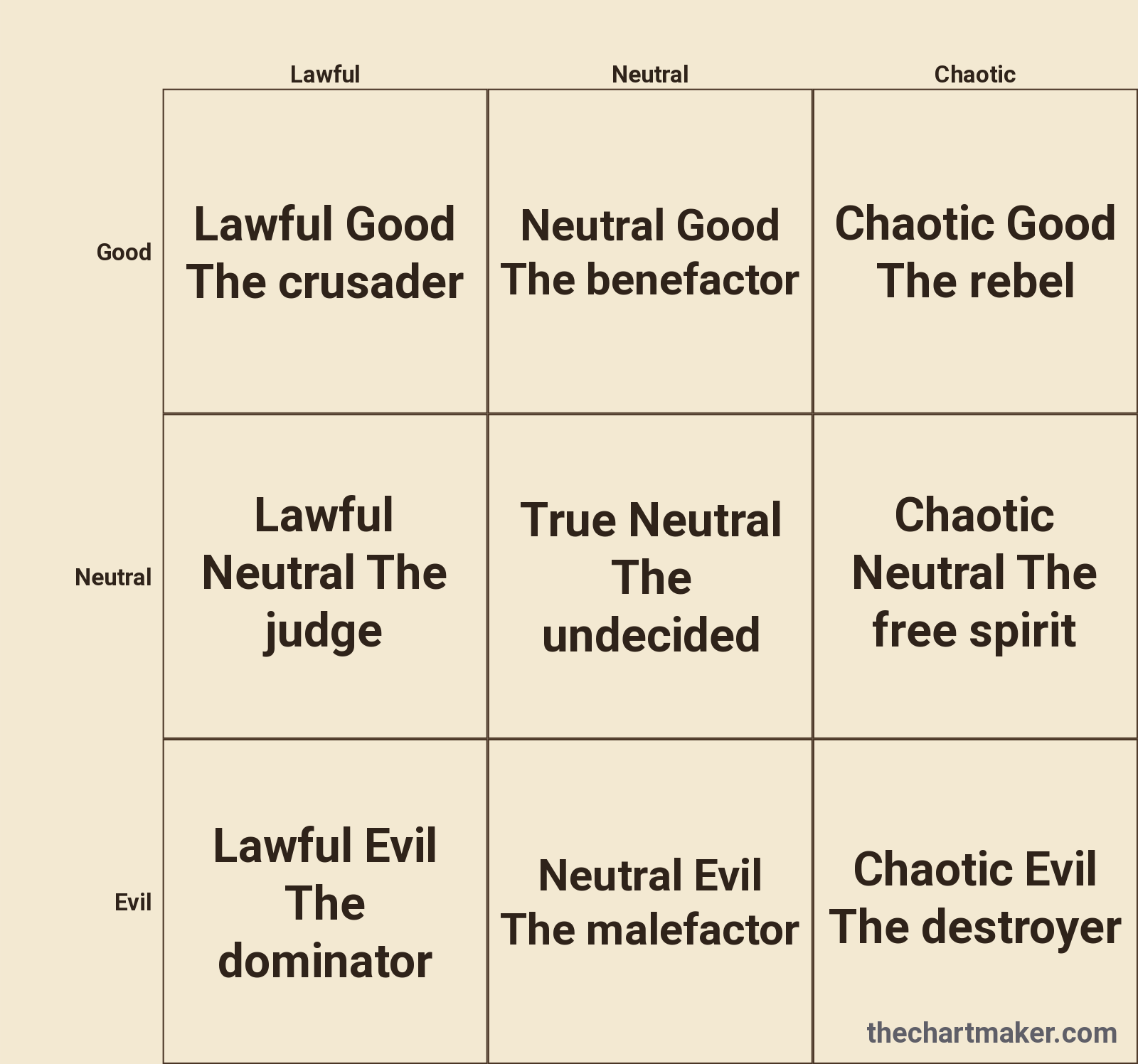
The Dungeons & Dragons alignment chart is a grid of nine cells. One axis runs lawful to chaotic. The other runs good to evil. Every character, and later every meme subject, is placed in one of the nine combinations. It is a moral map, not a ranking: two people can sit in the same cell and still be nothing alike, and two rivals can sit on opposite corners of the same row.
Fill in your party
This is the chart, already labelled, in the editor. Tap a cell to replace its placeholder with a character, a picture or a name, then export the nine cells as one PNG. Nothing is saved until you change something, and no account is needed to export.
The two axes
Lawful to chaotic is about how someone relates to rules, codes, and expected behavior. Lawful keeps the promise, follows the institution, or treats a personal code as binding. Chaotic treats those as optional and will break them when they get in the way. Neutral on this axis is not indecision; it is someone who uses rules when they help and ignores them when they do not.
Good to evil is about who the behavior is for. Good is willing to take a loss for someone else. Evil is willing to make someone else take a loss. Neutral on this axis looks after itself first and is not trying to be a villain or a saint.
The nine cells
- Lawful good: does the right thing the prescribed way. Knights, dedicated public servants, the friend who will not lie for you.
- Neutral good: helps, and will use the rules or skip them depending on which one actually helps.
- Chaotic good: helps, and will not wait for permission. Rebels with a cause, thieves who steal from worse people.
- Lawful neutral: the code is the point. Judges, bureaucrats, monks of a rule rather than of a god of kindness.
- True neutral: uninterested in the fight, or committed to keeping a balance rather than picking a side.
- Chaotic neutral: free, inconsistent on purpose, not trying to save you and not trying to ruin you.
- Lawful evil: harm, with a structure. Empires, contracts written to trap, villains who keep their word.
- Neutral evil: harm, without a speech about freedom or order. Selfishness with the gloves off.
- Chaotic evil: harm, and the rules were never going to survive contact. Destruction as a temperament.
From the table to the meme
Alignment started as a rule in Dungeons & Dragons for how a character was supposed to behave, with mechanical consequences if they drifted. The nine-cell picture outlived that. By the late 2010s it was a meme format: the axes stayed readable, the cells got photographs, and the joke was usually that a thing you recognized had been placed somewhere slightly mean.
That is why a blank alignment chart still looks like D&D even when the labels have been rewritten. People know where lawful good sits. Relabelling the axes is how the format does new work: "says it" against "does it", "looks cheap" against "is cheap", "would date" against "would trust".
Make one
The nine-cell alignment chart maker is the page for the classic grid: nine cells, pictures or text, PNG export, no account. The alignment chart maker is the same editor with other sizes in reach, including a four-box grid and a five-by-five, if nine cells are too few or too many. Templates live at alignment chart templates.
Common questions
What are the nine alignments?
Lawful good, neutral good, chaotic good, lawful neutral, true neutral, chaotic neutral, lawful evil, neutral evil, and chaotic evil. Lawful to chaotic is one axis; good to evil is the other.
What is lawful neutral?
Lawful neutral puts the code, the order, or the institution above kindness or harm. A judge who applies the rule as written, a soldier who follows the order, a paladin of the law rather than of mercy.
Is an alignment chart the same as a tier list?
No. A tier list is a ranking from best to worst. An alignment chart places things on two named axes at once, so two entries can be peers on one axis and opposites on the other.
Do the nine cells have to stay D&D labels?
No. The classic labels are how people recognize the format. The useful chart is often a relabel: hot to cold against cheap to expensive, or any two arguments you actually want to make.
Where can I make one?
The chart at the top of this page is the alignment chart maker, already labelled: tap a cell to put a character in it, then export the PNG. The classic nine-cell page opens the same labelled grid full screen.